News/
Column
Can You Trust the 60/40 Rule in Marketing?
Numbers look authoritative - especially with decimals. But in marketing, even the sharpest figures can rest on shaky ground. Here’s how to treat the famed 60/40 split with clarity, context, and calm.
Why precise numbers seduce smart marketers
Dashboards glow with accuracy; MMM decks promise simple answers. It’s human to trust what looks exact. Yet precision is not the same as truth. Two nearly identical brands, in the same category and market conditions, can receive MMM recommendations that point in opposite directions – e.g., out‑of‑home as “best” in one model and “worst” in another. That gap isn’t malice; it’s model design, input choices, and interpretation.
What the 60/40 rule actually says - and what it doesn’t
Les Binet and Peter Field’s widely cited guidance suggests roughly 60% of budget to brand building and 40% to activation. It’s powerful because it reframes marketing as both long‑term demand creation and short‑term demand capture.
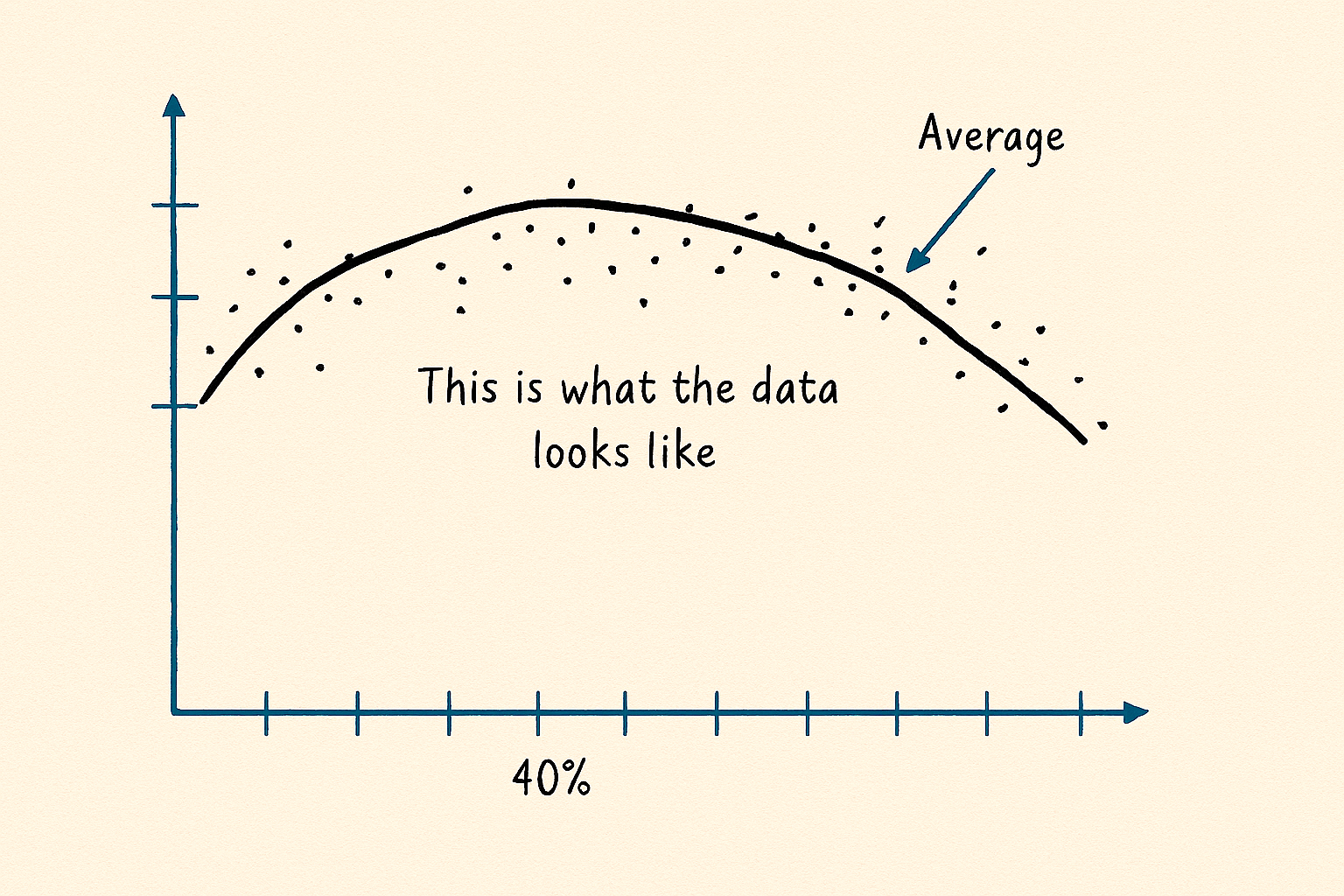
But it’s not a law of physics. In their underlying analyses, the optimal activation share shifts meaningfully by category dynamics, route to market, brand maturity, and competitive intensity—often landing anywhere from ~20% to ~49%. In other words: the “40” is a range, not a target you must bullseye.
Beware the illusion of exactness
Aggregate curves – built from many noisy campaign outcomes – can look deceptively crisp. Peaks appear, and we’re tempted to crown a single “best” point. Yet those tops are flat enough that moving a fair distance left or right barely changes outcomes.
To complicate matters, many input datasets depend on human reporting and classification (e.g., what counts as “brand building” vs. “activation” in a given award entry or internal taxonomy). If definitions differ, conclusions will too.
A practical way to use 60/40 without handcuffs
-
Start with the range, not the pointFrame allocation as brand: 50–70% and activation: 30–50%, then tune.
-
Map to your business contextAre you a newer/younger brand? Is your category price-sensitive or promotion-heavy?
-
Check the curve shapeIf returns are flat near the top, optimize for operational practicality (media availability, creative cadence, in‑market cycles) rather than chasing a single decimal.
-
Interrogate your MMMAsk how media carryover, seasonality, competitive spend, and diminishing returns are modeled; request out‑of‑sample validation and confidence intervals.
-
Define “brand” and “activation” upfrontAlign on taxonomy (by objective, audience, asset, and time‑horizon) to avoid apples‑to‑oranges analysis.
-
Set guardrails and learnUse quarterly budget bands (e.g., brand 55–65%) and run test‑and‑learn within them.
The Swedish “lagom” interpretation
The lasting lesson of 60/40 is balance: don’t starve tomorrow to feed today – and vice versa. You don’t need to hit exactly 60/40 to be effective. You do need a measured blend of long‑term brand building and short‑term activation that fits your category, growth stage, and commercial goals. In plain Swedish: lagom is best.
Bottom line
Use 60/40 to protect long‑term value while delivering short‑term results. Then adjust within a sensible range based on your market reality, data quality, and the flatness of the returns curve. Precision is comforting; context is what makes it profitable.
The article was initially published in the Swedish marketing trade magazine Resumé.